NITA dhar
Leadership is about using your skill to empower others
- Experience
- 34+ yrs
- Based in
- Latitude : 26.4920783 & Longitude : 89.5265801
- Speaks
- 8 languages
- Skills
- 15
About
Being born and brought up in the Dooars tea garden area (Hamiltongunj), Nita is well accustomed to the life and culture of the tea garden labourer among whom she grew up.
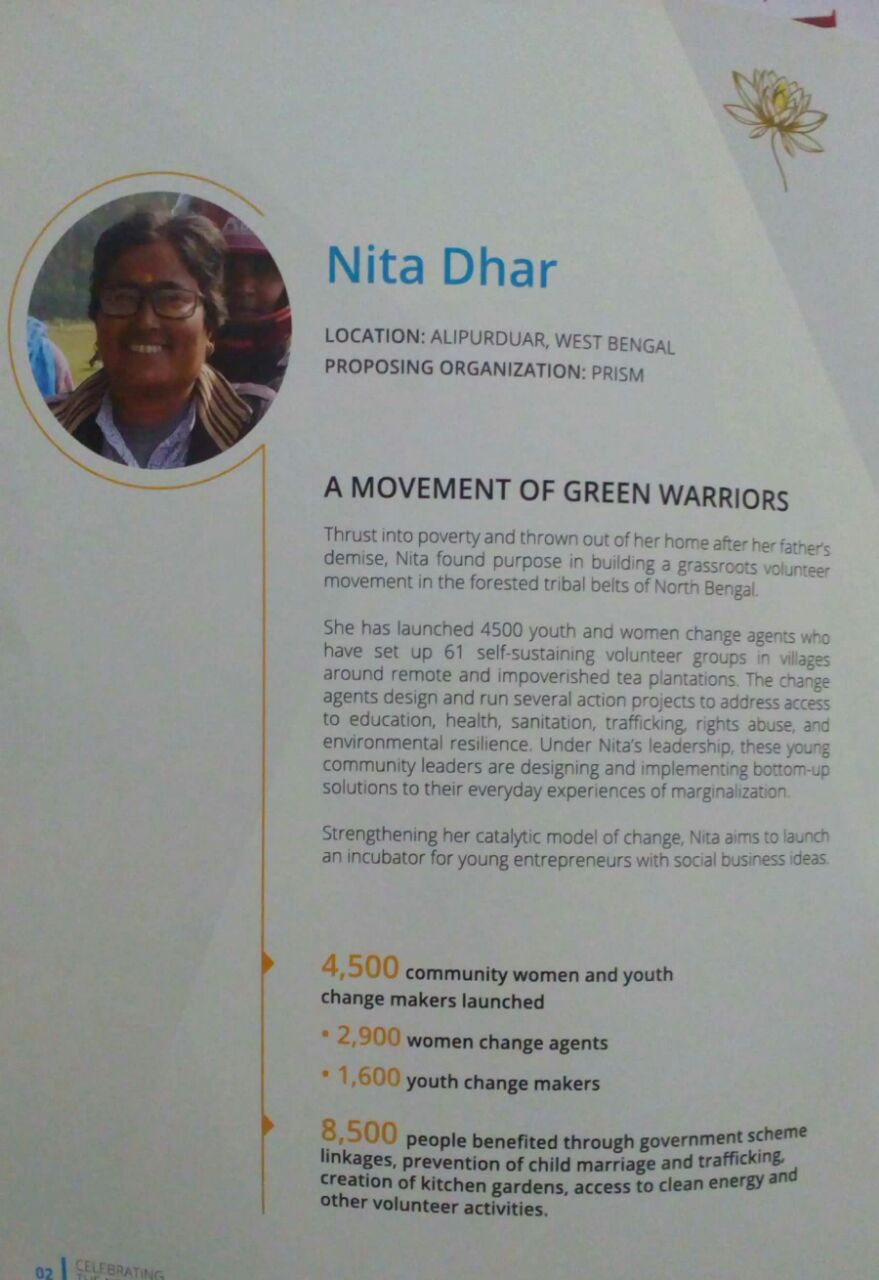
She saw their hardship - living from hand to mouth - and yet a simple and honest life style made them always smiling. This prodded her to do something for them who taught her how to remain always positive. Her experience with the life of the Christian Missionaries working selflessly among the garden labourer also was an inspiration. She pledged at a young age that she will devote her life to educate, to empower and to fulfil dream of the life for her tribal neighbour.
What I do
- Malaria Eradication
- CHILD PROTECTION
- HUMAN TRAFFICKING
- GREEN SCOUTS MOVEMENT
- SFAE WATER SYSTEMS
- CLIMATE SMART SOLUTIONS
- MENSTRUAL HYGIENE MANAGEMENT
- PARTICIPATORY DEVELOPMENT
- NATURAL FARMING
- FOOD ADULTERATION
- ANTI SUPERSTITIONS
- Reproductive Child Health (MCH/RCH)
- SOCIAL ENTREPRENEURSHIP
- SEARCH & RESCUE
- FOOD SOVERIGNITY-SAFETY-SECURITY & NUTRITION
Experience
- 1992-08-17 – 2008-08-20An NGO in Kalchini Block of Alipurduar district (erstwhile Jalpaiguri district), West Bengal. The work was targeted to tribal women tea labour and other marginalized women in tea gardens and forest dwelling communities of Dooars areas and focused on Safe Motherhood and Prevention of Child Mortality. The targeted women didn’t have access to any basic health care facility because most tea gardens and surrounding areas did not have any health services during that time. Her task was to educate those poor and vulnerable women about basic personal health & hygiene to prevent maternal and infant mortality and malnutrition and linking the beneficiaries with the State Mother & Child Health/Reproductive Child Health Programme (MCH/RCH) and Integrated Child Development Scheme (ICDS).
Nirmala Health Centre, Kalchini, Alipurduar
- 2008-08-21 – 2021-12-20PRISM - Professional Institute for Development and Socio Environmental Management'
A non-governmental, non-profit organization registered under West Bengal Societies Registration Act 1961, is set up in 2000 to develop and implement solutions that balance the need for food, shelter, income and environmental quality prescribed for all. Our work is guided by our objectives for long term development.
Our Focus:
The unexpressed and most felt needs of the vulnerable sections of the society especially women and children;
Undertaking research and action programme for integrated development of the poorer and weaker sections of the society;
Making people aware about developmental activities, social change and various forces acting in the process and endeavor to enable them to actively participate in the design, implementation and continuing operation of those activities to their best advantages.
The key sectors of interventions are Environment, WASH, Livelihood and Women & Children's Development. Gender issues are given priority. The central theme of the strategies is capacity building and a process of empowerment to enable people to manage the activities by themselves, during and after our intervention. As a facilitator PRISM views its intervention as tool for capacity building and focuses on organization building and human resource development. Groups and organizations of the neediest and the marginalized are supported to increase their participation and enable them plan, prioritize and implement actions at their own pace. PRISM is primarily aiming at developing a sustainable, integrated and people-centered development strategy generated through field experiences. It has a team of professionals with expertise in areas such as Multi-pronged Research & Development, Partnership Management, Benchmark Studies, Training & Documentation, Participatory Monitoring-Evaluation-Learning, Developing MIS & Strategies, CSR Planning & Facilitation, etc. to fully meet the project requirements and to ensure timely delivery of the outputs to the highest quality. PRISM takes up research and consultancy jobs through which resources pulled together and implementation works at the field supported. Mainly a grassroots organization and we can provide only Technical support such as capacity building of the workers of other grassroots organization, transfer of rural technologies, consulting services to the government and other agencies in terms of evaluation, research, training, developing IEC materials, documentations, etc.
Professional Institute for Development and Socio Environmental Management - PRISM (NB)
- 2021-12-21 – 2023-08-29Barnali Pello Jukki Foundation is a Private incorporated on 21 December 2021. It is classified as Non-govt company and is registered at Registrar of Companies, Kolkata. Its authorized share capital is Rs. 0 and its paid up capital is Rs. 0. It is inolved in Social work activities
Barnali Pello Jukki Foundation's Annual General Meeting (AGM) was last held on N/A and as per records from Ministry of Corporate Affairs (MCA), its balance sheet was last filed on N/A.
Directors of Barnali Pello Jukki Foundation are Nita Dhar, Bhaswati Dey Kundu and Kalpana Karjee.
Barnali Pello Jukki Foundation's Corporate Identification Number is (CIN) U85300WB2021NPL250439 and its registration number is 250439.Its Email address is prismnb.05@yahoo.in and its registered address is PRISM-NB Campus, Pradhan Nagar P.O - Madarihat Alipurduar Jalpaiguri WB 735220 IN .
CIN- U85300WB2021NPL250439
Registration Number - 250439
Date of Incorporation - 21 December 2021
Activity - Social work activities
DIRECTOR: NITA DHAR, DIN - 09443454, Appointed as Director from 21 December 2021
BARNALI PELLO JUKKI FOUNDATION
Education
- 1985-01-02 – 1992-03-30UNION ACADEMY, KALCHINI
Union Academy Kalchini High School ; Place Types, : School ; Address, : Kalchini, Earstwhile Jalpaiguri dist (now Alipurduar Dist.,) West Bengal, India. UNION ACADEMY, KALCHINI was established in 1953 and it is managed by the Department of Education. It is located in Rural area. It is located in KALCHINI block of ALIPURDUAR district of West Bengal. The school consists of Grades from 5 to 12. The school is Co-educational and it doesn't have an attached pre-primary section. The school is N/A in nature and is not using school building as a shift-school. Bengali is the medium of instructions in this school. This school is approachable by all weather road. In this school academic session starts in April. The school has Government building. It has got 11 classrooms for instructional purposes. All the classrooms are in good condition. It has 2 other rooms for non-teaching activities. The school has a separate room for Head master/Teacher. The school has Pucca But Broken boundary wall. The school has have electric connection. The source of Drinking Water in the school is Tap Water and it is functional. The school has 5 boys toilet and it is functional. and 4 girls toilet and it is functional. The school has a playground. The school has a library and has 2000 books in its library. The school does not need ramp for disabled children to access classrooms. The school has 18 computers for teaching and learning purposes and all are functional. The school is not having a computer aided learning lab. The school is Provided and Prepared in School Premises providing mid-day meal.
26°41'05.2"N 89°25'07.3"E
- 2010-07-01 – 2012-07-31Rabindra Mukta Vidyalaya
The West Bengal Council Of Rabindra Open Schooling As formal education could not reach out to all sections of the society covering all categories of people, Open Learning System makes it possible to include different sections of men and women of different age group. To meet the need for Open Learning System State Open School came up as a wing of the School Education Department in 1997. Renamed as Rabindra Mukta Vidyalaya (RMV)in 1998, it grew into a Statutory Organization with effect from 1st August, 2001 on the basis of Rabindra Mukta Vidyalaya Act, 2001, passed by the West Bengal State Legislature. The Act has been amended first in 2002 and next in February 2006. The amended Act has come into effect from the 1st January, 2007. According to the amendment of February, 2006 the Rabindra Mukta Vidyalaya has been renamed as the West Bengal Council of Rabindra Open Schooling (WBCROS). The West Bengal Council of Rabindra Open Schooling imparts open learning through self-study materials and personal contact programmers. More flexible and less rigid rules and procedures have been formulated taking into account the special need and circumstances of the target group of learners for whom the WBCROS is conducting study, examination and certification at the Secondary (class X) and Higher Secondary (class XII) levels. From the point of view of its constitution and responsibilities, this Council is analogous to other State Boards, Councils like the West Bengal Board of Secondary Education, West Bengal Board of Madrasah Education or the West Bengal Council of Higher Secondary Education. The West Bengal Council of Rabindra Open Schooling is recognized by the Government of West Bengal as well as the Government of India, the National Institute of Open Schooling (NIOS),other Boards etc and it is a member of the Council of Boards of School in India (COBSE). The West Bengal Council of Rabindra Open Schooling is aimed at providing Secondary (Madhyamik) and Higher Secondary levels of education to the millions of disadvantaged learners, school drop-outs, unemployed and self-employed young men and women, whole time or part time workers in different establishments, peasants and elderly men and women, unsuccessful learners of formal system, physically and mentally challenged, slow learners and other weaker sections of the people. The Prisoners in some of the major Correctional Homes of West Bengal can also be admitted & enrolled as learners of WBCROS. The study Centres of WBCROS are located mostly in Government aided Secondary, Higher Secondary Schools, and Madrasahs spread over all the districts of West Bengal. The learners are admitted & enrolled through online system in the Study Centres, spread all over the State. Minimum age of admission in the Madhyamik Course is 14 years and educational qualification must be class VIII passed from any Govt. recognized school who are under the COBSE. There is no upper age limit. A learner can take admission to Higher Secondary level if he or she has passed out Secondary Examination from WBCROS, WBBSE or any other recognized Board or Council under COBSE .Enrollments or admissions are made twice for the Secondary level and once for the Higher Secondary level in a year through online system by the respective study centre. The learners are provided with study materials by this Council, prepared specially for self and open-distance learning mode of study. Once enrolled, a learner gets five years time for sitting in the examinations. Thus he/she gets nine chances to appear in the Madhyamik Examination and five chances to appear in the Higher Secondary Examination. There is provision for transfer of credit for students coming out unsuccessful from other Boards/Councils with partial success in some of the subjects. Also there is provision for accumulation of credit, so that a learner may sit in the examination of this Council several times with limited number of subjects finally to clear all the subjects thereby becoming successful in the concerned level of study through credit accumulation. The West Bengal Council of Rabindra Open Schooling conducts three examinations in a year- two for Madhyamik and one for Higher Secondary .Madhyamik Examinations are held twice a year- once in June and the other in December. Higher Secondary Examination is scheduled to be held once in a year. It is to be mentioned here that the WBCROS has many aspects common in its aims and objectives, procedures, methodology, ways and means with those of the national counterpart, National Institute of Open Schooling (NIOS). The WBCROS has its own curriculum or curricula for in the Madhyamik (Secondary)& Uchcha Madhyamik (Higher Secondary) Level and has own syllabi or syllabus for the different subjects offered in this course . These are very similar to the syllabi & curriculum offered by the formal system of education in West Bengal. Based on these, Self Learning Study Materials (books) have been developed by this Council with assistance from subject expert committees, especially for study in the Self Learning mode. The required numbers of various volumes of these Self Learning Study Materials ( books ) are printed and prepared which are then distributed by this Council amongst the enrolled learners through the Study Centres. The Self Learning Study Materials (books) distribution exercise has to be undertaken by the WBCROS thrice every year, twice after Registration /Enrolment of learners for the Secondary level in June & December for Madhyamik (Secondary) level and once after Enrolment/Registration of learners for the Uchcha Madhyamik (Higher Secondary) level .Personal Contact programme (PCP) are arranged free of cost at the study Centres for the learners. Attendance at the Personal Contact programme (PCP) is not compulsory for the learners. But for laboratory based subjects for the Uchcha Madhyamik (Higher Secondary) course, the attendance of learners at the practical classes is compulsory. Since its inception The West Bengal Council of Rabindra Open Schooling (erstwhile State Open School) has been discharging its mission to promote the cause of education among older section of people of the society and school drop-outs. It is also inspiring to know that female members even from weaker sections are coming out of all social barriers to take the unique opportunities offered by the West Bengal Council of Rabindra Open Schooling and are getting themselves educated. The enrolment figures of students/learners as well as the figures for examinees show that the female candidates from all categories of the population participate in larger numbers.
WEST BENGAL
Work


Let's work together
NITA dhar · Leadership is about using your skill to empower others
Readable by AI assistants: view NITA's card